
Home Advisor treats termites in homes, offices, shops and commercial buildings across Rawalpindi, backed by a written warranty of five to ten years. Our head office is in Bahria Enclave, Islamabad, with teams reaching Pindi the same day. Inspection is free, the quotation is fixed, and most properties are finished in a single working day with no need for the family to move out.
Most people postpone treatment while the damage still looks small a nibbled door frame hardly feels urgent. The maths, though, works against that instinct.
A single, priced job with a certificate attached to it.
Priced per square foot of treated area, quoted once after a free survey
Comes with a 5–10 year written warranty on company letterhead
Protects the timber you already own — nothing gets ripped out
A recurring bill with no certificate and no ceiling.
One hardwood door, one fitted wardrobe or a kitchen cabinet run can cost several times a preventive treatment
In pre-1987 Pindi houses with timber roof structures, the figures shift sharply structural wood must be addressed, not just decorative
New joinery in an untreated house is simply fresh food for the same colony
No warranty, no documentation, no comeback
Termite damage discovered during a property survey drags buyer offers down and the conversation shifts from price to repair liability. An active termite proofing certificate does exactly the opposite: it removes the objection before it is raised.
Three things about this city make pest control in Rawalpindi more urgent than most homeowners realise and all three are invisible from the street.
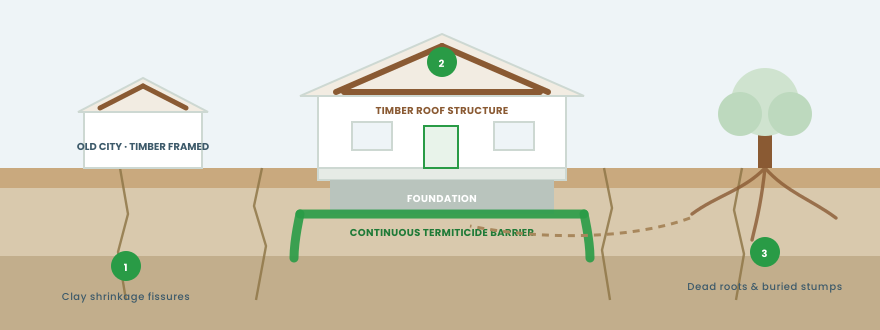
Cross-section: Pothohar clay cracks give termites ready-made tunnels to the foundation (1), structural roof timber above the barrier is a second food source (2), and colonies living in garden roots relocate into the house when their host tree goes (3).
Rawalpindi’s clay swells when wet and contracts sharply through the dry summer, leaving cracks that run deep below the surface. Termites use those fissures as ready-made tunnels to reach the foundation which is why they so often arrive without ever building visible mud tubes on the outside walls.
Large parts of Pindi Raja Bazaar, the Saddar lanes off Committee Chowk, Bhabra Bazaar are built with timber beams, joists and wooden roof structures that predate any idea of pre-construction treatment. Here wood is load-bearing, not decorative, so a colony in it is a structural problem rather than a cosmetic one.
The established trees across the Cantonment areas, Westridge, Chaklala and the older housing schemes host termite colonies for years. When a tree is felled or a garden relandscaped, the dead roots and buried stumps stay and the colony simply moves to the next food source, which is usually the house.
No equipment is needed to catch termite activity early. Walk your property once and look carefully at these six places, in this order.
If any one of them looks suspicious, book an inspection. A contained colony costs a fraction of one that has reached the floor structure.
Look for narrow lines of dried mud running upward from the skirting or the base of the wall. This is the clearest sign that subterranean termites are active.
Knuckle-tap the lowest six inches of every frame and work outward. A hollow, papery sound means the inside has already been eaten away even though the paint looks intact.
Pull out the lowest shelf and inspect the back panel and base. Damage almost always starts there, long before anything shows at the front.
Files, old books and cartons are frequently attacked before furniture is. Lift a stack and check the underside and the floor beneath it.
Persistent damp attracts colonies. Look for blistered paint or lifting plaster where there is no visible leak behind it.
Check the outside face of boundary walls near ground level, plus any dead roots, damp patches or buried stumps in the garden.
Four treatments, chosen after the survey not sold as a package. Soil work stops what comes from beneath; wood work deals with what is already inside.
Applied before the flooring goes down. We build a termiticide barrier through the foundation trenches, the plinth fill and along the external wall lines, so that every footprint of the building rests on treated soil. It is the cheaper and stronger option no drilling, no restoration and it matters especially in Rawalpindi, where clay movement can open fissures around a structure within months of completion.
For a building that already stands, the barrier is built from above. Holes are drilled at set intervals along the floor-to-wall junction and the perimeter, then termiticide is injected under pressure into the soil beneath so the chemical spreads laterally into one unbroken barrier. Every drill point is sealed and the finish restored before we leave. In older Pindi houses we survey the beams, joists and roof space as well a generic treatment fails here precisely because only the soil gets done while the structural timber above the barrier keeps the colony alive.
Deemak spray is applied to door and window frames, wardrobes, kitchen units, wooden panelling, staircases, beams and furniture using equipment that reaches into joints, hinges and back panels the places a brush or an aerosol never gets to. Furniture with live infestation is treated by direct injection into the affected sections rather than surface spray alone. This is the part of the job that protects the timber sitting above the soil barrier.
Clearing the current colony is half the work; keeping the next one out is the other half. Through inspections and scheduled visits our technicians identify the specific weak points on your property cracks opening in the floor slab as clay shrinks, damp around bathrooms and kitchens, planters built hard against external walls, dead roots near the boundary, firewood or cartons stored directly on bare ground. Each one gets corrected, which turns prevention into something measurable rather than a claim on a receipt. Commercial properties can take this as an annual contract with scheduled visits.
This is how a standard residential job runs from arrival to handover. Larger properties or severe infestations may run into a second day.
The technician walks the property with you, reviews its condition against the quotation, and identifies which rooms need furniture shifted away from the walls.
12 mm holes are drilled at roughly one-foot intervals along the wall bases and the building perimeter, positioned to minimise disturbance to tile and marble.
Termiticide is injected under pressure at every drill point so it spreads laterally through the soil and forms one continuous barrier rather than a row of isolated wet spots.
Wooden fixtures, furniture frames and roof timber receive surface treatment and direct injection wherever live activity is found.
Every drill point is sealed and finished, furniture is put back where it was, and the site is cleaned properly.
You receive the certificate stating the product used, the dosage applied and the exact warranty period it carries.
Nobody needs to move out. We only ask that children and pets stay clear of the working area while the team is in the house.
Four termiticide formulations are commonly used here. They differ in residual life, how they travel through soil, and crucially whether termites can detect them.
Undetectable to termites. They walk through treated soil and carry the active ingredient back into the colony.
Same transfer effect at a higher concentration, with the longest residual life of the four. Our usual recommendation for post-construction work in Pindi.
Slow-acting and spread by contact and feeding, so it moves steadily through the colony rather than killing on the spot.
Creates a fast-acting exclusion barrier that blocks and kills on contact. Works by keeping termites out rather than eliminating the nest.
All products are registered with the Department of Plant Protection, applied at label dosage, and are low-odour to odourless — safe for households with children, elderly residents and pets. Home Advisor stocks all major brands; if you have a preference based on research, past experience or an architect’s specification, we will arrange it.
Because termites cannot detect Fipronil or Imidacloprid, they keep walking through the treated soil, picking up the active ingredient and passing it to nestmates through grooming and feeding. The result is colony elimination, not merely suppressed activity which is what you want when clay movement means a barrier may never stay perfectly sealed.
Bifenthrin works by exclusion. Applied properly it is an effective barrier with no gaps, and it acts fast but it depends on that barrier remaining continuous. For post-construction work in Rawalpindi we prefer non-repellents for exactly that reason.
Killing the termites you can see does nothing to the colony underground. That is why a shop spray appears to work for a fortnight, then the problem surfaces in another room.
Only the termites visible on the surface
The colony in the soil, which is never visible from above
The spot where they were spotted
Full perimeter and floor-to-wall junction barrier
Guesswork from a can
Calculated per square foot by a trained technician
Returns within weeks, often in a different room
Colony eliminated
None
5–10 year written guarantee
Repeat purchases plus the eventual repairs
One-time cost with free re-treatment inside the warranty
Treatment is priced per square foot of treated area, so no honest quote can be given without seeing the property. Four things move that figure.
Total square footage needing treatment, including basements and ground floors.
Treating one affected room costs considerably less than an infestation running across an entire floor.
Fipronil 5% SC costs more per litre but buys a longer warranty. That trade-off is yours to make.
Marble and tiled floors, basements and old timber-framed buildings need more drilling and more labour.
Our inspection is free and the quotation that follows is firm nothing is added afterwards. If a price arrives without anyone having seen your property, and it sits well below the market, it usually signals thin dosage or partial coverage. That work fails quickly, and you pay twice.
There is no shortage of termite control companies in Rawalpindi. Few will hand you documentation stating the product, dosage and warranty terms before you pay. Ask every specialist you speak to for it it is the only way to compare quotes fairly.
Stating the termiticide product name, the dosage and the warranty period in writing, before payment.
Trained in dosage calculation, drilling patterns and safe handling not simply handed a sprayer.
We show you the unopened container before mixing, so you know exactly what is going into your home.
The price listed is the price paid. No revisions once the team is on site.
If termites return to a treated area during the warranty period, we come back at no cost.
Timber roof structures and pre-partition buildings need a different survey from a new build, and we treat them differently.
Looking for termite control near you in Rawalpindi? Our teams work these areas daily — and our Bahria Enclave head office keeps response times short across the whole city.
Home Advisor covers Rawalpindi and Islamabad as a single service area, so if you have property in both, the treatments can be scheduled together on one visit. We also operate termite control services in Lahore, Karachi and Faisalabad with 24-hour support.
The cost is calculated per square foot of treated area and depends on property size, infestation level and the termiticide chosen. The inspection is free and the quotation issued afterwards is firm. Call 0300 8503029 to arrange an assessment.
Most homes are completed within one working day. Larger properties, commercial buildings or severe infestations may take two days.
No. Termiticides are applied directly into soil and wood rather than released into the air, and they are low-odour to odourless, so you can stay throughout. We only ask that children and pets stay clear of the working area.
Yes, when applied correctly. All products are registered, dosed to label specification by trained technicians, and become inert once dry. Treated areas are safe within about 24 hours.
Between five and ten years depending on the formulation. Fipronil 5% SC gives up to 10-year protection, and your certificate lists the exact period.
Re-treatment of the affected area is free for the duration of the warranty. That commitment is written on your certificate, not promised verbally.
Yes — and it should be. Older Rawalpindi properties with timber roof structures need the beams, joists and roof space assessed alongside the soil treatment, otherwise the colony survives above the barrier. We cover both.
Yes. Pre-construction anti termite treatment is the cheaper route because it goes in before the flooring is laid. Contact us at foundation stage to avoid floor restoration costs later.
Yes. Our head office is in Bahria Enclave, Islamabad, and we serve both cities — visits in Rawalpindi and Islamabad can be arranged together.
Depending on location, usually the same or the next day. Call 0300 8503029 or send a WhatsApp message with your location to confirm a slot.
Our Team will get back you soon!