
Home Advisor provides professional termite control in Karachi for houses, apartments, offices, shops and warehouses. Treatments are carried out by trained technicians using registered termiticides, and every job is backed by a written warranty of five to ten years depending on the product used. Inspection is free anywhere in Karachi, quotations are fixed, and most properties are treated in a single working day without anyone needing to move out.
Termite (deemak) inspection, treatment and proofing
Houses, apartments, offices, shops, warehouses, under-construction sites
Fipronil 2.5% EC, Fipronil 5% SC, Imidacloprid, Bifenthrin
One working day for most homes and flats
No products are low-odour and applied into soil and wood
Coverage: DHA, Clifton, Gulshan, Johar, North Nazimabad, Bahria Town and more. See full list
Written warranty
Inspection city-wide
Typical home or flat
DPP-approved products
Karachi gives subterranean termites something they rarely get elsewhere in Pakistan: a year without a break. Four coastal conditions do the damage here is where each one sits in a typical Karachi property.
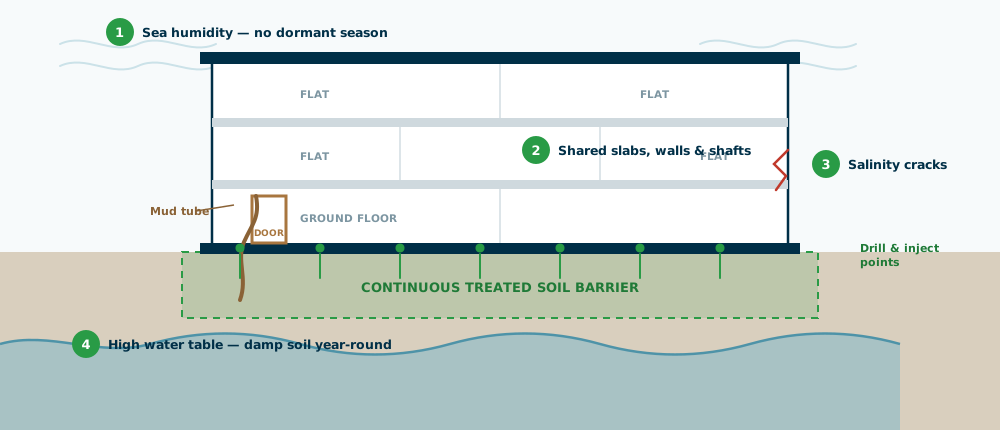
Cross-section of a typical Karachi property. Numbers 1–4 correspond to the conditions below.
In cities with cold winters, colony activity slows for two or three months. On the coast it does not. Humidity from the sea keeps the soil moist through most of the year, so feeding continues month after month a colony that would take four years to cause visible damage inland can do it here in two.
In a multi-storey building, a colony is almost never confined to one unit. It moves through shared slabs, common walls and service shafts, which changes how treatment has to be planned and why treating one apartment alone rarely holds.
Salt in Karachi soil and groundwater slowly degrades plaster and opens hairline cracks in floor slabs and boundary walls. Termites do not create those cracks they simply use them, travelling from soil into the structure without ever appearing on the surface.
Across large parts of the city the water table sits close to the surface. Damp soil under a building is exactly the environment a colony needs, and it also means any gap in a chemical barrier gets exploited quickly.
This is why deemak control in Karachi so often needs to address the building envelope, not just the room where the damage was noticed.
Termites feed from the inside outward, so a door frame can be almost hollow while still looking untouched. Walk your property and check these seven signs.
Narrow, dried lines of soil running up skirting boards, pillars or boundary walls. The single most reliable sign of subterranean termite activity.
Tap a wardrobe or door frame. A light, papery sound means the timber has been eaten from within.
Frames swell as termites damage the wood and trap moisture inside it.
Small translucent wings collecting near tube lights, windowsills or in corners after humid weather.
Surfaces that bubble with no leak behind them.
Pinholes in wood with a sawdust-like residue below.
Stored paper in cupboards and storerooms is often hit before the furniture is.
One sign is enough to justify an inspection. Termite damage compounds a small, contained colony costs a fraction of what the same colony costs after it has spread across a floor.
Two types matter for Karachi properties, and they require different treatments. Our technician confirms which one you have during the inspection.
Underground, in soil near the building
Mud tubes on walls
Soil barrier — drilling and injection
Fast; large colonies
Inside the timber itself
Small pellets like coarse sand
Direct wood injection and spray
Slower; smaller colonies, mostly in furniture
Most termite pest control work in Karachi deals with subterranean termites, which is why soil treatment forms the core of the job. Treating a drywood infestation with a soil barrier alone will not solve it which is why we identify the type before quoting.
Two barrier treatments do the structural work. Three supporting services handle the wood above the barrier, the weak points around it, and buildings too large to treat unit by unit.
Applied while a building is going up, before flooring is laid. A termiticide barrier is established in the foundation trenches, across the plinth fill, and along the external wall line, so the entire footprint of the structure sits on treated soil. This is the strongest protection available and the cheapest per square foot, because no drilling or restoration is involved. In Karachi it is particularly worthwhile a high water table makes later retro-treatment more demanding.
Foundation trenches treated before backfilling
Plinth fill saturated before the slab is poured
External wall line treated after finishing
Pipe and conduit entries treated individually
Written warranty
Lowest cost basis
When a property is already built and termites have appeared, the same barrier is created from above using the drill-and-inject method. Holes are drilled at measured intervals along the floor-to-wall junction and around the perimeter, and termiticide is injected under pressure so it disperses through the soil beneath. Once the barrier is continuous, the colony loses its route into the building. Drill points are then sealed and the finish restored. For flats, we assess adjoining units and the ground floor before quoting treating one apartment in isolation while the colony keeps feeding next door is the most common reason a previous treatment has failed when clients call us.
12mm holes at roughly one-foot intervals
Pressure injection for continuous lateral spread
Adjoining flats and ground floor assessed first
Drill points sealed, finish restored, site left clean
Most homes and flats
No need to vacate
The soil barrier handles what is below; wood treatment handles what is already above it. Applied to door and window frames, wardrobes, kitchen cabinets, panelling, staircases and furniture, using equipment that reaches into joints, hinges and back panels where termites actually travel. Actively infested furniture is treated by direct injection rather than surface spray alone.
Treatment removes the colony you have; proofing stops the next one settling in. Our technicians identify the specific weak points on your property cracks in floor slabs, damp around bathrooms and kitchens, expansion joints, planters built against external walls, and timber or cartons stored in contact with the ground and fix them alongside scheduled follow-up inspections.
For apartment blocks, offices, schools, hospitals, godowns and factories we plan treatment across the whole structure ground floor, shafts, common walls and stores and schedule work outside business hours where required. Work at this scale is quoted after a full site survey, never over the phone.
Seven stages, in order. A typical house or flat is completed within one working day.
A technician surveys the property, identifies the termite type, locates entry points and maps how far the colony has spread. You receive a written scope and a fixed quotation.
We recommend a termiticide based on infestation level, construction type and the warranty length you want and explain the reasoning before starting.
12mm holes at approximately one-foot intervals along wall bases and the perimeter, positioned to minimise disturbance to flooring.
Termiticide is injected so it spreads laterally through the soil and forms one continuous, unbroken barrier.
All wooden fixtures, furniture and vulnerable timber receive an application.
Every drill point is sealed and finished; the site is left clean.
You receive a written certificate covering free inspections and re-treatment for the full warranty period.
One working day for a typical house or flat. Larger properties and warehouses may need two.
There is no single best termiticide the right choice depends on the property, the infestation level, and how long you want the protection to last. These are the four formulations used seriously in Pakistan.
Undetectable to termites; carried back into the colony
Higher concentration, longest residual life in soil
Slow-acting; spreads through contact and feeding
Fast-acting barrier that blocks and kills on contact
The non-repellent products deserve particular attention. Because termites cannot sense Fipronil or Imidacloprid, they walk straight through treated soil, pick up the active ingredient, and pass it to nestmates through grooming and feeding. The colony is eliminated rather than merely blocked. A repellent like Bifenthrin works differently it forms a barrier termites avoid, which is effective but relies on that barrier having no gaps. Home Advisor stocks every major brand. After inspection we recommend the formulation best suited to your property and budget and explain exactly why. If you would prefer a particular brand or active ingredient from your own research, a previous good experience, or your architect’s specification tell us and we will arrange it for your job. Every product we apply is registered with the Department of Plant Protection and used at label-recommended dosage. All are odourless or low-odour, so the property remains safe for children, elderly residents and pets.
Pricing is calculated per square foot of treated area, so no honest quotation can be given over the phone without knowing the property. Four factors decide the figure.
The square footage requiring treatment, including any basement or ground floor.
A localised problem in one room costs considerably less than an established colony spread across a floor.
Fipronil 5% SC costs more than Bifenthrin, and carries a longer warranty in return.
Tiled and marble floors, basements and multi-storey buildings require more drilling and more labour.
Be cautious of any company that quotes a firm price before seeing the property, or one that quotes far below the market the usual explanation is a diluted dose, which fails within months and leaves you paying twice. Our inspection is free and the quotation issued afterwards is fixed. Nothing is added later.
During building, before flooring
Soil barrier laid in trenches and plinth fill
Entire footprint of the structure
Lower per square foot
Up to 10 years
New houses and projects under construction
Any time after the building is complete
Drilling and pressure injection
Perimeter and affected areas
Higher includes drilling and restoration
5–10 years by product
Existing homes, flats and offices
If you are building in Karachi, pre-construction anti termite treatment is the better decision by a wide margin. It costs less, lasts longer, and requires no drilling into finished floors later.
What we put in writing before you pay, not after.
On company letterhead, stating the product name and warranty period in full.
Technicians trained in dosage calculation, drilling patterns and safe handling not just spraying.
We show you the unopened container before mixing so you can verify what enters your home.
The price given after inspection is the price you pay.
If activity returns inside the warranty period, we return at no cost.
Planned across floors, shafts and shared walls what Karachi buildings usually need.
Same-day service available across Karachi for urgent cases.
Home Advisor also serves Lahore, Islamabad, Rawalpindi and Faisalabad.
Karachi has no shortage of termite control companies. What is uncommon is one that will put the product, the dosage and the warranty period in writing before taking payment. Home Advisor does and we would encourage you to ask every termite specialist you contact for the same before deciding. If you are comparing quotes for the best termite treatment in Karachi, that document is the fairest thing to compare.
Looking for termite control near me in Karachi? Our teams work across:
If your locality is not listed, call us we cover most of Karachi including the surrounding industrial zones.
Cost is calculated per square foot of treated area and depends on the size of the property, how far the infestation has spread, and the termiticide selected. Inspection is free and the quotation issued afterwards is fixed. Call 0300 8503029 for an assessment.
Most homes and flats are completed in one working day. Large properties, warehouses, or severe infestations may require two days.
No. Termiticides are injected into soil and applied to wood rather than released into the air, and they are odourless or low-odour. Residents can stay throughout. We only ask that children and pets are kept away from the working area while the team is on site.
Yes, when applied correctly. All products are registered, dosed to label recommendations by trained technicians, and become inert once dry. Treated areas are safe within a few hours.
Between five and ten years depending on the formulation. Fipronil 5% SC gives the longest cover at up to ten years. Your warranty certificate states the exact period for the product used.
Re-treatment of the affected area is free within the warranty period. This is written into your certificate, not offered verbally.
Yes, but the assessment must go beyond your own unit. Colonies travel through shared slabs, common walls and service shafts, so we inspect adjoining flats and the ground floor before planning treatment. Treating a single flat in isolation usually gives temporary results.
It kills the termites you can see, which are a small fraction of the colony. The nest stays in the soil and keeps feeding. Without a soil barrier, the infestation reappears within weeks usually in a different room, which is why people often think it is a new problem.
Once the warranty period ends. With Fipronil 5% SC that is around ten years. We recommend a free inspection every one to two years in between, particularly for ground-floor properties.
Yes. Pre-construction anti termite treatment is applied before flooring is laid and is the most cost-effective protection available. Contact us at the foundation stage rather than after the floor is finished.
Our Team will get back you soon!